
Respiratory Season OSHA Checklist: N95s, Fit Testing, and Training for Healthcare Practices
Every fall, waiting rooms fill with coughs and sniffles, and practice managers face the same question: when staff put on N95 respirators, what does OSHA actually require of us?
The answer depends on one key distinction. Is respirator use required by your practice, or is it voluntary? This guide explains OSHA’s Respiratory Protection standard in plain terms, shows how it applies to outpatient healthcare, and ends with a checklist you can work through before respiratory season peaks. All regulatory citations link to the current Code of Federal Regulations so you can check the source.
Why respiratory protection belongs in your OSHA for healthcare plan
Most practices already focus on the familiar OSHA for healthcare standards: bloodborne pathogens, hazard communication, and PPE. Respiratory protection is often handled informally. Someone orders a box of N95s, and staff wear them when a patient seems sick.
OSHA’s Respiratory Protection standard, 29 CFR 1910.134, is more specific than that. If your practice requires employees to wear respirators, the standard sets out a full program: written procedures, medical evaluations, fit testing, and annual training. An N95 filtering facepiece respirator counts as a respirator under this standard. A surgical or procedure mask does not.
Required use vs. voluntary use: the distinction that drives everything
When respirator use is required
If your practice requires respirators, for example by telling staff to wear an N95 when caring for patients with suspected airborne illness, then the employer must “develop and implement a written respiratory protection program with required worksite-specific procedures” (29 CFR 1910.134(c)). That program must be run by a suitably trained program administrator.
When respirator use is voluntary
Some staff choose to wear an N95 even when you don’t require it. The standard allows this as long as you determine that the respirator use “will not in itself create a hazard.” You must also give those employees the information in Appendix D to 1910.134, “Information for Employees Using Respirators When Not Required Under the Standard” (1910.134(c)(2)(i)).
There is an important exception. If an employee’s only voluntary use is filtering facepieces (the standard calls them “dust masks”), you do not have to include that employee in a written program (1910.134(c)(2)(ii)). You still need to provide the Appendix D information.
Practical takeaway: Decide on purpose, and in writing, which situations in your practice require respirators. That decision determines how much of the standard applies to you.
What a required respiratory protection program includes
If respirator use is required, plan for these core elements.
1. A written program and an administrator
The written program should be specific to your worksite. It should cover which tasks require respirators, which respirators you use, and how you handle each element below. OSHA’s Respiratory Protection eTool and small entity resources include sample materials.
2. Medical evaluation
Before an employee is fit tested or required to wear a respirator, the employer must provide a medical evaluation to confirm the employee can safely use one. Appendix C to the standard contains the mandatory OSHA questionnaire.
3. Fit testing
Employees using tight-fitting facepiece respirators, which includes N95s, must be fit tested “prior to initial use of the respirator, whenever a different respirator facepiece (size, style, model or make) is used, and at least annually thereafter” (1910.134(f)(2)).
The phrase “different model or make” matters during supply shortages. If your usual N95 is back-ordered and you switch brands, staff who will wear the new model need a new fit test.
4. Use, cleaning, and maintenance
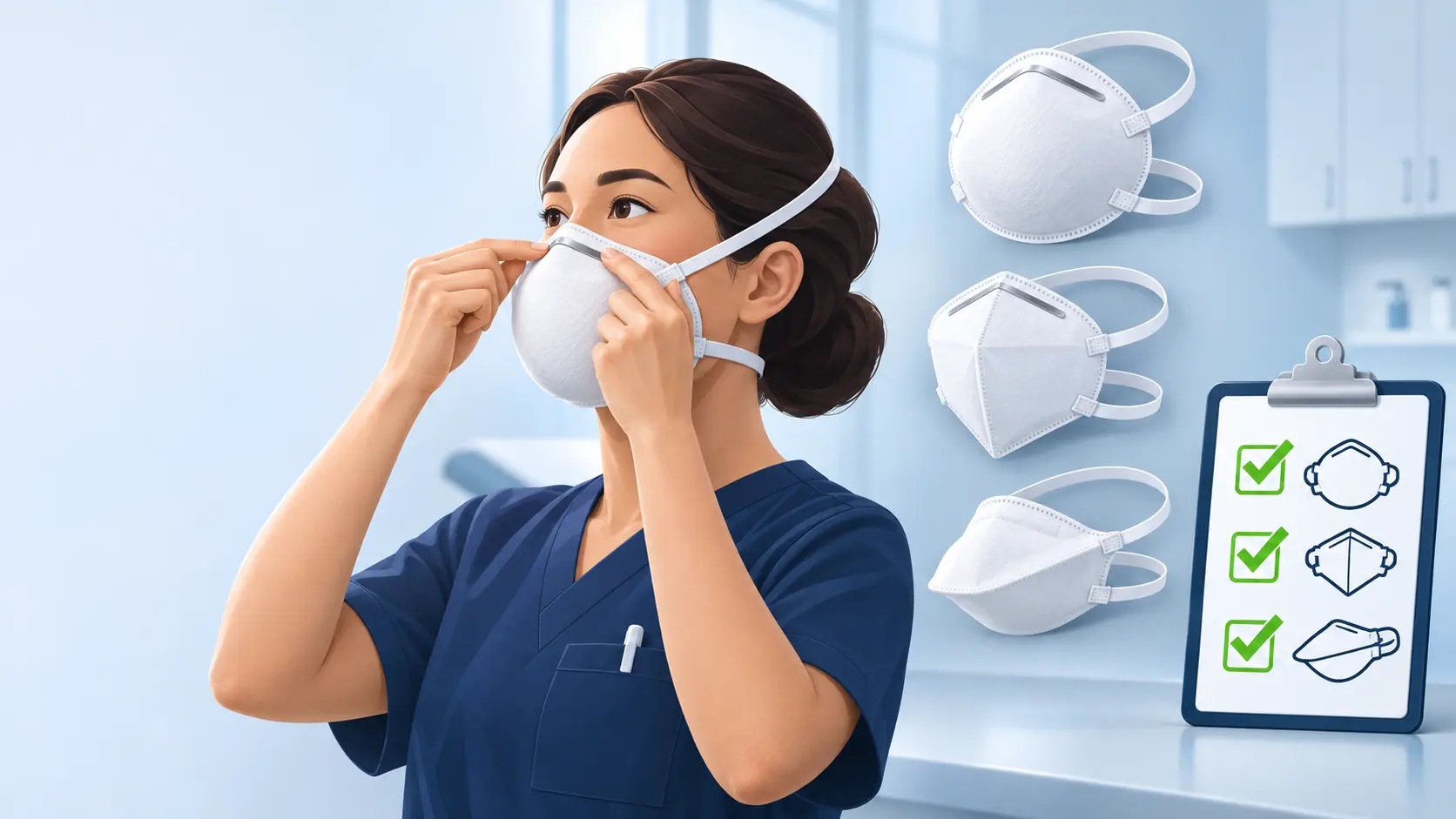
The program must address proper use, including seal checks each time a tight-fitting respirator is put on, and how respirators are stored, cleaned, and replaced.
5. Annual training
Employees required to use respirators must receive training that is “comprehensive, understandable, and recur[s] annually, and more often if necessary” (1910.134(k)). Training should cover why the respirator is needed, its limits, how to put it on and check the seal, maintenance and storage, and how to recognize medical signs that may limit use.
6. Recordkeeping
Keep records of medical evaluations and fit tests. Fit test records must be kept until the next fit test is administered (1910.134(m)).
How respiratory protection connects to your other training
Respiratory protection rarely stands alone. In a practice setting, it overlaps with the broader infection control program described in our patient safety and infection control playbook for outpatient clinics, including:
- Infection control, including source control for patients, triage, and hand hygiene. See Infection Control for Healthcare Workers and Hand Hygiene training.
- Personal protective equipment. The general PPE standard (29 CFR 1910.132) requires a hazard assessment and PPE training. See PPE for Healthcare Workers.
- Tuberculosis exposure. Respirators are a core control for TB. See TB Protection for Healthcare Workers.
- Environmental cleaning of exam rooms between patients. See Environmental Cleaning: Exam Rooms.
For why hand hygiene matters so much during respiratory season, see how hand hygiene training helps prevent illness. Online courses are a good fit for the knowledge parts of this training. Fit testing and hands-on donning and doffing still need to happen in person.
Respiratory season OSHA checklist for practice managers
- Decide and document when respirator use is required in your practice
- Name a program administrator, and write or update your respiratory protection program
- Confirm medical evaluations are complete for staff who must wear respirators
- Schedule annual fit tests, and re-test anyone switching to a different N95 model
- Provide Appendix D to staff who wear respirators voluntarily
- Complete annual respirator training and record it
- Refresh infection control, PPE, and hand hygiene training before peak season
- Check your N95 inventory and the models staff were fit tested on
- Add respiratory protection to your 2027 healthcare compliance training plan
- File medical evaluation and fit test records where you can find them
Frequently asked questions
Does OSHA require fit testing for N95 respirators in healthcare?
Yes, when respirator use is required by the employer. Employees using tight-fitting respirators such as N95s must be fit tested before first use, whenever they switch to a different size, style, model, or make, and at least annually (29 CFR 1910.134(f)(2)).
Is a surgical mask a respirator under OSHA?
No. Surgical and procedure masks are not respirators under 29 CFR 1910.134. N95 filtering facepiece respirators are.
What if staff wear N95s voluntarily?
The employer must make sure the use won’t itself create a hazard and must give the employee Appendix D of 1910.134. If the only voluntary use is filtering facepieces, a written program is not required for that employee (29 CFR 1910.134(c)(2)).
How often is respirator training required?
Annually, and more often if necessary, for employees required to use respirators (29 CFR 1910.134(k)).
Do we need a new fit test if we change N95 brands?
Yes. A new fit test is required whenever an employee uses a different respirator facepiece size, style, model, or make.
Can respiratory protection training be done online?
The knowledge parts, such as hazards, limits, and maintenance, can be delivered online. Fit testing and hands-on practice with the specific respirator must be done in person.
Get your team ready for respiratory season
Evolve eLearning has supported healthcare compliance since 2003. Our OSHA training for healthcare organizations lets you train your whole practice online, track completions, and keep 365-day access to courses. Pair infection control, PPE, and TB courses, or start with the OSHA Essentials 5-Course Bundle. Volume discounts are available for larger teams.
This article is provided by Evolve e-Learning Solutions for general educational and informational purposes only and does not constitute legal or professional advice. Laws, regulations, and compliance requirements may change or vary by organization and jurisdiction. Readers should consult qualified legal counsel or compliance professionals to determine their specific obligations. Evolve does not guarantee compliance with any applicable law or regulation.
Share this article


Related Posts